Thursday, March 4, 2010

The dog-shaped hole in my heart...


From my earliest memories, I have always been bewitched by dogs. At a very young age, I was very, very determined to get a puppy and being equally persistent about voicing this desire. I distinctly did not want a baby brother or sister but a floppy-eared, wet-nosed, four-legged bundle of wiggly, yipping energy? Sign me up. I'm not sure how the decision came about that, yes, a puppy would be a fine addition to our nutty house on Romona Road, but the puppy of my dreams did indeed materialize when I was four. And almost just as abruptly, he disappeared from my life.

His name was Duffy and he was a tri-colored beagle. He was eight-weeks-old and, like all puppies, he packed a genetically favorable combination of heart-melting charm along with his sharp-as-needles teeth. I remember bouncing out of bed every morning like I had like I had a coiled spring underneath me to rescue Duffy from the cage where he slept at night. I loved everything about him, including his always searching, pain-inflicting teeth: I loved Duffy's puppy breath. I loved his high-pitched barks. I loved feeling his heart beat like a metronome on speed with my little hand pressed against him. I loved watching him sleep, messily snort up his kibble like a vacuum cleaner run amok, bounce through the grass in our back yard like he was exploring the jungle. I wanted to marry Duffy when I grew up.

My mother did not share my affection for him.

I remember her following our ever-kinetic puppy around the house with carpet cleaner, a roll of paper towels and a forehead that would grow more furrowed by the day. Duffy and I were oblivious for the most part: I was too busy trying to dress my squirming puppy in my sun hat and put him in my baby carriage. Duffy, of course, was immersed in his schedule of chewing, bouncing and peeing. My mother kept a fastidious home, though, and so Duffy became her nemesis with an unstoppable bladder. Unbeknownst to me, he was living on borrowed time at our home. First Duffy was confined to the basement. That was okay: I set up a special love den for us there with extra pillows and chew toys. Then he ripped up the couch, scratched the wood panels on our TV set (this was the 1970s), created a malodorous, widening yellow stain on my mother's new carpet. Chewing up the telephone cord was apparently the last straw. Duffy was on his way out.

One morning, through behind-the-scenes machinations unknown to me, my grandfather came to our house and picked up my sweet Duffy, his cage and toys. It was all sprung on my brother and me at the last minute. Duffy was going to "a farm" my mother explained. He would be happier there. He would have the space he needed. He would have other dogs to play with. I nearly lost my mind with grief. I sobbed and pleaded as I watched my grandfather load Duffy up into his Buick and drive away, but even as I did, I knew it was both final and futile. My mother cried along with me and my brother but her jaw was set in a certain way that let me know she was serious about excising this nuisance from her life. Duffy was in and out of our lives in about two weeks time. Every last trace of him, except the aftermath of his plundering, was erased. I would wonder about Duffy through the years, imagining him as he grew older, trying to envision this verdant farm where he allegedly went to live. I cultivated a vivid fantasy of loading up a hobo pack with dog biscuits and squeaky toys, running off to find Duffy and stealing him back at night. We would snuggle for warmth on train cars. When I imagine him now, I see him in snapshots, those bright, thick Kodak photos from the era. He's frozen in time, a puppy forever, no grey to ever creep up on his muzzle.

For years, I whined and cajoled and guilt-tripped and pestered for another dog. When I was ten, my mother bought a parakeet instead, thinking this would somehow placate me. My mother, never much of an animal person, didn't realize the extent to which I had a dog-sized hole in my heart. Chipper, the poor little parakeet, did nothing wrong except be born a bird and given to a girl who wanted nothing but a dog. Alas, he did not satisfy my itch in the slightest. He chewed on his wobbly penguin toy with a compulsive fervor, singing strange, torturous songs to himself, until his beak became warped (I say this now, fully horrified by my negligent care of him) and when he died two years later while I was at overnight camp, I was sad but quickly ready to move on. Where was my puppy?

When I was in seventh grade, my tireless campaign to get another puppy finally bore fruit. (Maybe this set the stage for me becoming an activist later?) I was told that if i got an A on our huge government test, I could choose my prize. Of course, without a second wasted, I knew what would be in the pot at the end of the rainbow: a bouncing baby dog. Not knowing anything about companion animal overpopulation or the benefits of adoption, I had my heart set on a buff-colored cocker spaniel. I trained like a triathlete and got an A on the government test and every day after, I would circle puppy ads in the classified section of the Chicago Tribune and read them to my mother. I had a list of names I kept in my notebook, and I still remember some of them: Taffy, Pumpernickel, Butterscotch. (My animal naming skills have improved considerably since then.) Finally, the day came when I could be put off no longer: we loaded up the car and drove to a house a million miles away or maybe in Wisconsin. There was the puppy for me, surrounded by his litter mates, sleepy-eyed and silky and perfect as he rested on a dog bed. I scooped him up in my arms, a million little cartoon hearts audibly popping all around my head like bubbles. This one! I would get teased for years after for naming our boy dog Buffy, but I guess I was still mourning that lost beagle puppy, by that point solidly middle aged, who had been wrenched so hastily from my four-year-old all those years prior.

Buffy. Oh, Buffy. Perfect blond, wavy locks like a canine, cross-dressing Farrah Fawcett. Beautiful, graceful profile. Sad, sweet, droopy eyes. How were we to know that under this gorgeous exterior beat an inbred heart filled with unbridled, easily provoked, unpredictable rage? Buffy was a biter, not a nipper: he was a Cujo-like creature out for blood. Buffy had to walk around the house with his leash on because otherwise he would try to forcibly remove your hand when clicking it on. Buffy also relieved himself on the carpet. No matter: I loved him. Even my mother, so intolerant of his predecessor years earlier, loved him. We just understood from the outset that he was not one of those cuddly dogs. Buffy liked to be loved at a distance. Sometimes one could forget this, though, and get deluded into thinking that he was as sweet inside as outside. Once he was lying on my bed with me and I made the grievous error of startling him with a pet: he pounced on me and pinned me down, this little thirty pound cocker spaniel, snarling and drooling and crazy-eyed just an inch from my face. The face of Old Yeller after his tussle with the rabid raccoon. I didn't dare move an inch, frozen there. Fortunately my brother happened to poke his head in my room: he threw a pillow at Buffy and he jumped off me and ran under the bed.

We learned to live with Buffy, the occasionally terrifying despot, and we forged a relative peace. Still, this was clearly not the cuddly dog of my dreams, the one I would skip off into the horizon with, the girl and her dog. He did start the chain of dogs I have lived with over the years, though, one that was largely uninterrupted until recently. After a string of fostering gigs with the shelter I worked at after I graduated college - there was Sweetpea, Marley, the brown shepherd mix I've got photographic evidence of but have long since forgotten the name of - Lenny arrived in my life with my new boyfriend, now my husband.

Lenny was The One. He was bliss and perfection in dog form, at least to us. We adopted him from a friend who saw him out on the street and had been trying to catch him for weeks. He was an adult dog, perhaps two, a long and short beagle-basset-cattle dog mix, or so we guessed, and covered with fleas. His little paws stuck out like duck feet and he had an oversized, beagle head. When we first adopted him, Lenny had somewhat of a goofy appearance because he was underweight, which made his head look even bigger; people would tell us he looked like several different dogs stitched together. His eyes were beautiful beyond description but I'll do my best: large, almond-shaped and the color of shiny, new pennies, his eyes were generously rimmed with soft, thick eyelashes he let me brush my index finger against and then accentuated again with a black outline, like an Egyptian pharaoh. Lenny would look deeply into my eyes and seem to want to talk: I think we were both frustrated by this. Even though there were limits to our ability to communicate, he still got his point across, whether he was howling with his beautiful, sonorous voice or taking in the world with his proud, regal bearing. Lenny fit into our lives seamlessly and was never like our child: he was immediately and completely an equal. He wouldn't settle for less. We took trips with Lenny, went with him to the beach, spent so much time just loving him. When I was away, even for the day, I felt like I had little wings at my feet, I was so eager to see my Lenny, my angel. He's been gone for eight years now, dying two months to the day before my son was born (also with those frequently commented on big, soulful eyes), and I miss him pretty much every day. The intensity of the grieving lessens over time but the void is still there, still keenly felt. You know how when you meet someone and it's like you've always known one another, there's that elusive, soul-gratifying connection, that instant feeling of "this is family"? I had that with Lenny. I am convinced that he was a true soul mate of mine in canine form. Mementos of Lenny in photographs are scattered throughout the house: smiling at the forest preserve, dignified near a tacky "Injun" statue along Route 66, following a scent on some long-forgotten path, and I always feel something like a magnet in my chest, wanting to pull him back here with everything I've got. Oh, Lenny. You inspire purple prose...

Buster was the second dog we adopted, overlapping with Lenny. He was the Yin to Lenny's Yang, the peanut butter to Lenny's jelly, the bitter to Lenny's sweet. Buster had a challenging early life, coming into our home as a six-month-old basset hound who'd already been turned into the shelter for aggressive behavior and housebreaking issues. Of course I was arrogant enough to assume that with my affection and superior skills, Buster's true, sweet nature would be able to emerge. Nope. He was who he was. He was eight before he was housebroken and aggressive until his dying day. I remember my son, at two, walking past Buster just to be growled at. My son came to me, sobbing, hugging me, "But I love doggy!" How can you explain this to a two-year-old, that sometimes our love doesn't matter? By the time Buster passed away, last February, my son was six and he had an understanding of the dog. Like Buffy, Buster expected you to love him from afar, although even that might warrant a suspicious growl. Buster helped to teach our son that there were all kinds of personalities out there and not everyone wants to be loved in the same way. To love Buster was to simply accept him. I loved Buster - definitely different in nature than the deep connection I had with Lenny - and it manifested more as a quiet, simple allowing of him simply to be himself with no strings attached or expectations. In other words, loving without condition. Just as my love for Lenny helped me to grow, my love for Buster also enriched my life, teaching me that it's easy to love another when there are no conflicts. The real test of my character was to love despite conflicts.

After more than a year without a dog, the longest stretch I've gone since Buffy, I am ready to love again. The dog-shaped hole in my heart that I felt so keenly as a child is still there, pounding away with its sad emptiness. We have a kitty we adopted two years ago and I am besotted with her and her little black-spotted nose. Clover has the most feminine little meow. My son adores her and oversees her education at Clover School a few times a week, even keeping a folder where he charts her progress. (It's all very cute: her schedule, which he writes on his chalkboard, is always something like Cat Recess, Cat Library, Cat Climbing, Cat Snack, Cat Second Recess, etc., with the word "cat" always preceding activities.) I love Clover but my heart also pines for the mutual affection and deep personal connection one gets with a dog (experiences with Buffy and Buster notwithstanding). Dogs are just so sanguine and physically present. My husband, the chief dog-walker and primary hold out, knows that he can't put off the tag team of me and my son much longer. Maybe this spring there will be a dog full of love and affection for us at the shelter? It'll be a match made in heaven. Maybe he'll have floppy ears? Maybe he's a she? Maybe he will wag his tail so hard - thump-thump-thump! - against the floor when we get ready to take our daily walk to pick up my son at school?

No matter what form our future dog takes shape, I know he is out there and my dog-shaped hole will be filled all snug once again.

Wednesday, February 24, 2010

Veganism, feminism, integration...


Ever since I was old enough to form a self-aware thought, I was a feminist. More accurately, I was a pre-feminist: feminism implies, at least to me, that there is something in the world that feminists are responding to: inequality, injustice, fewer opportunities, something bad. As a young child, I was blissfully unaware that there were even those who considered anything but absolute shoulder-to-shoulder equality. Thankfully, I grew up before Disney had princessified girlhood, thus it never occurred to me to aspire to being such a creature. Like the other daughters of second wave feminism, I would go wherever my myriad electrifying passions took me. My Barbie proxy figure hung out at the beach with Skipper and Ken from time to time, but she also traveled the world as a high-stakes business woman and volunteered as a veterinarian and rescued horses from equine-oppressing dolls with evil eyebrows drawn in with a ball point pen. My desk drawers were messily stuffed with the loose papers upon which I mapped out my future: what my house would look like (there was always an indoor pool in the basement), stories about the mysteries I would solve, the secret worlds I would discover. Why would I think anything wasn't available to me? I believed that I was born into a benevolent matriarchal dictatorship with my grandmother as good-natured empress and everyone else falling into line behind her. Though the women in my family pulled the strings to make their units function well, they had to keep up appearances that their marriages were egalitarian to be nice. This was all just for appearances, I was certain. I extrapolated it to become my earliest interpretation of women in the world.

And then the real world started trickling in. I would watch All In The Family and wonder what that Archie Bunker character was talking about anyway, always mocking the "women libbers" on the show. He was just stupid, right? But Edith, his wife, would greet Archie at the door, as endlessly sunny as Archie was scowling. Why was she subservient to anyone, let alone such a grouch? And what was this Equal Rights Amendment, anyway, the thing that was making everyone so upset on the news? Why was something like the ERA even necessary? Of course we were equal. Whoever thought otherwise? Lots of people, it turned out. I started to notice that the principal and superintendents at school were always men. All the presidents were men, too. Nixon, Ford, Carter, Reagan and all the men around them: one after the next, like a row of mechanical ducks at the carnival game. I saw my mother, hardly an avowed feminist, derided by the fathers at the Little League games when she was coach of my brother's team, the only female coach in the league, time and time again. I remember one opposing coach telling my mother that she was out of her element, that she should join the PTA instead. My mother didn't skip a beat when she informed him that she was also president of the PTA, her arms folded in front of her chest, just short of saying, "And what have you done lately?" He stormed off in a huff, I remember the cloud of dust puffing up behind him, as my mother savored the moment before she resumed her coaching. The battles she couldn't win at home, she would win on the field.

Watching my mother and her friends and the world around me, my natural response was to become a feminist. It was as intuitive to me as turning on the light when you're trying to see in a dark room. Of course! It was the same thing when I became a vegetarian at fifteen. It was utterly natural, putting my beliefs into practice. My feminism and my veganism grow from the same seed, even from the same root. They have both been nurtured by my unquenchable drive to live a passionate, honest life. Just like a plant stretches toward the sun, that is how I stretch. To me, it is only natural for vegans to be feminists and feminists to be vegans. Otherwise, it seems that something went wrong with the growth of the seed somewhere.

The food animals most abused and exploited are female. The layer hens that produce egg after egg until they are calcium deficient, crippled and spent at a year or so. The female dairy cows with swollen, infected udders and prolapsed uteruses, having been turned into virtual meat and milk machines. The enslavement in cages and crowded buildings, the forced impregnations (rape in our species), the stealing of babies, of milk intended for their babies. To my mind, it is only natural for a feminist to be deeply and personally appalled. And thus it seems natural to me that feminists should strive toward a vegan diet. ( I do understand that this is part of the luxury of my privilege talking: just the fact that I can choose what to eat and what not to eat is a position of enormous privilege.)

By the same token, it would seem that a vegan - someone who is guided by principles of compassion and freedom and the inherent dignity of all - would be a feminist. As has been documented frequently in our shock-value driven popular culture, this is not a natural conclusion for all. I have been disappointed and perplexed again and again by those I assume I am walking shoulder-to-shoulder with, only to discover that my vegan colleagues - people who will stand up for a newborn chick's right to autonomy and dignity - think it's perfectly acceptable for a woman to strip on camera while reciting statistics about the exploitation of animals. The refusal to acknowledge and address the obvious intersectionalities of exploitation is one of my biggest disappointments with both feminist and vegan communities. What is the hold up?

I am far from perfect. I stick my foot in my mouth, act impulsively, look at the world from a position of privilege way too often. I understand that. The point is, though, to evolve, right? To find areas that are malnourished and cultivate them better. I don't think it's enough to acknowledge weakness, shrug and say, well, that's how I am. Of course we need to accept that we're imperfect, but striving toward ethical consistency is not the same thing as perfectionism, at least not to me. I know that we all have contradictions and areas of inconsistency: is it enough to just admit to that? I don't think so, not if we're trying to live mindfully.

I guess part of the answer is that we all have different orientations and interpretations of things. Relativism gets on my nerves, though, so much blunting of anything worth saying. Perhaps an answer is that veganism is more specific: it expects certain beliefs and practices, though anyone who has spent time with a group of vegans knows that we are hardly walking in lockstep on everything. Feminism, though, is more open to interpretation, less specific, more personal in ways. I can accept that, totally. But for vegans to downplay the importance of feminism, well, that is highly agitating to me. Same thing for feminists who choose to ignore their participation in oppression as omnivores. It seems clear that I haven't changed much from that little girl who simply did not understand disconnection: I am still seeking integration and connection everywhere and am deeply rattled when it's not there.

One day, it'll all make sense. Or I'll just learn to live with that which doesn't.

Friday, February 19, 2010

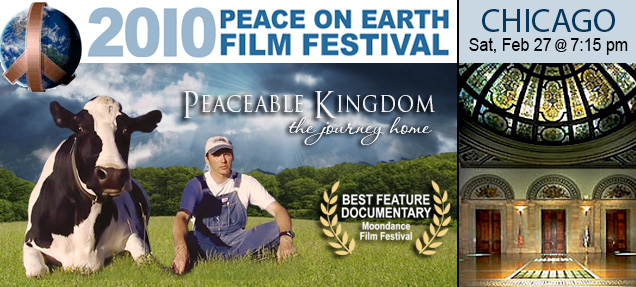
Peaceable Kingdom: The Journey Home free screening on Feb. 27!


The vegan community is fortunate to have an abundant creative population that is mining their talents to insert the message and tools for compassionate living into the larger culture. From entrepreneurial efforts, such as Ethically Engineered, the local personal care products makers, to prolific, thoughtful authors such as Colleen Patrick-Goudreau and a million points in between, vegan culture builders are indeed making inroads on influencing our meat-eating society. When we think about the how deeply entrenched cruelty to animals is in our mainstream culture, and how immense the suffering and scale is, it's very easy to become overwhelmed. We are taking on something huge here, giving voice to something that others more often than not do not want to hear. Given that, I am thoroughly uplifted when I think about how penetratingly the compassionate living culture is beginning to influence society. Far from the days when I became vegan in 1995, when we had our teeny meetings in church basements with the same (often mentally ill) people week after week, today's vegan population is much more widespread, diverse and influential. It's very exciting to be a part of, needless to say.

Of course, one of the most visceral tools we have for influencing society is through the medium of film. Documentary films in particular can be powerfully life-altering as viewers are given a lens into a world they rarely see. There is little that is as hidden from public view as the treatment of animals in society, particularly that of those animals that we use for our purposes. We want to keep living our convenient, familiar lives with the blindfolds that ignorance affords us. Thankfully, there are a couple of very talented filmmakers who are determined to thoughtfully and bravely raise public consciousness on this. The filmmakers, Jenny Stein and James LaVeck, are partners in Tribe of Heart, director and producer respectively. Their films have won numerous awards, such as Best of Festival at the Crested Butte Reel Fest and Best Documentary at the Brooklyn Film Festival and the Canyonlands Film Festival. They are not a couple of slackers walking around with a video camera and hoping for the best. They are thoughtful, deeply moving and powerful filmmakers that create change without manipulation.

I saw their first film, The Witness, in 2000. A window into one man's transformation from "regular guy" into a passionate champion for animals (and the creative tool he constructs for getting the word out), The Witness is about reinvention and redemption, and the fact that no matter our backgrounds, we can always become more compassionate, engaged, fully alive individuals. It is a beautiful film. The screening I was at - admittedly one at a vegetarian event, so full of sympathetic viewers - was filled with tears and smiles at the end. Tribe of Heart films will break your heart a little, but they will also uplift it. When we screened The Witness at The Conference For Conscious Living in front of nearly 300 people in 2001, it was a profoundly moving shared experience. People left the conference that day full of community spirit and eager to be compassionate advocates for animals.

Their eagerly anticipated new film, Peaceable Kingdom: The Journey Home, is now doing the film festival circuit and picking up awards along the way. Even though it's early into their circuit, they've already won the Best Feature Documentary at the Moondance Film Festival and Official Selection at numerous other film festivals. With Peaceable Kingdom: The Journey Home, the Tribe of Heart crew again brings us a story of deeply personal transformation. The film explores the lives of several people who grew up in traditional farming communities and households, and, how along their individual paths, their consciousness and spirits became awakened. The individuals featured now work on behalf of animals and have profound convictions about interconnectedness and compassionate living. This is a feature length film. I can't promise that you won't cry, but I will promise that you will leave uplifted. Of course, Peaceable Kingdom: A Journey Home also explores the complex emotional lives of the farm animals themselves.

Peaceable Kingdom: The Journey Home will be screening at The Peace On Earth Film Festival at the Chicago Cultural Center, 78 E. Washington Street, on Saturday, February 27 in the Claudia Cassidy Theater. It is free of change and first come, first seated. The film will be shown in a block at begins at 7:15; their film begins at 8:15 but expect that you should come for the whole block to ensure seating. Harold Brown, a subject of the film and a former beef farmer, will be at the screening, as will the filmmakers, Jenny Stein and James LaVeck. A Q&A will follow the screening. You won't want to miss this sure-to-be amazing experience. Extra vegan points brownie points if you bring an omnivore!

Please spread the word. You never know how many lives you can influence. Please RSVP at the Facebook event page. I hope to see you there!

Thursday, February 18, 2010

Sicko...

It started out with my son throwing up Monday night. By today, Thursday, we've had the hand of sick paint our house a putrid green. So sadly, no updates this week. Someone get me some miso soup. Thankfully my son is well and back at school so the pall of sick was at least merciful that way. Anyway, back to bed. Be well, everyone...

Thursday, February 11, 2010

Fifty Healing Choices For Type A Do-Gooders...


Sometimes you just wake up in a funk. Or you wake up just fine but then you pull something in your neck in the shower, and you get a kind of passive-aggressive email from someone you sort of really dislike, and you fell asleep early so now you have to deal with your kitchen and you just have too much to do. You know, one of those days. Maybe it's because I don't have a steady job, just this sort of gauzy goal of writing a best-selling Great American Vegan Superhero Coming of Age Novel in between freelance projects, but I feel very driven to stay busy with saving the world. I don't like to slow down and I really resent that sleep is essential to one's mental and physical health. But sometimes it is the sore neck that is the universe's message that you cannot just go on at warp speed: you must slow down. Internalizing the message that we have to take care of ourselves is not always easy, at least for me. Others are human, others need to nurture themselves, that is fine for them. For me, though, i need to keep charging forward. I have had friends voice concerns to me about how little I sleep, how hard I am sometimes on myself, and I realize that they're right. I am just as mortal and fallible as anyone else. So now I have this sore neck that is forcing me to dial things down a bit and I'm thinking about self-nurturing. We all need it. Here's a list of what you can do for yourself when you feel depleted and enervated, things to bring you just a moment or two of pure pleasure. I hope this helps.

Fifty Ways To Self-Nurture, Get Out of That Funk, or Just Plain Enjoy Life A Little More...

1. Buy some clementine oranges. Keep them in the fridge so they're nice and cold. Eat them one after the next.

2. Take a bath with scented salts, your favorite book, candles, the works.

3. Make a lunch or dinner date with a great, lovely, inspiring friend. Set aside at least an hour for this, aim for two.

4. Eat something with some high quality, serotonin-increasing fat in it. Some ideas: a big green salad with avocado and toasted walnuts, Thai food with coconut milk, hummus made with hemp or flax seed oil.

5. Use your leftover cell phone minutes and call a faraway friend.

6. Movie night! Make some popcorn and watch a movie that always makes you laugh. Or if you need the release, one that always makes you cry.

7. Do not disregard the guilty pleasure of occasional empty calories: reality TV, trashy magazine, Chick-O-Sticks. Whatever it means to you.

8. Go for a walk. It doesn't matter how it is outside. Dress appropriate to the conditions and take a nice meandering walk for at least thirty minutes. Or a nice bike ride.

9. Make a "feel good" album on your portable media player, full of the music that just fills your heart with joy. Listen to it. Enjoy it. Sing along.

10. Buy your favorite kind of pen, bring a notebook or a journal, and go sit in a café. Write letters to a friend, a letter to yourself, a gratitude list, get something off your chest. There is something about the act of putting a pen to paper that is healing and complete in a way that typing is not.

11. Are you dehydrated? A big glass of herbal iced tea or just plain water is often the easiest, quickest, most sure-fire way to help you feel better. Those of us who do too much can neglect this.

12. A few squares of dark chocolate can go very far to elevating the mood.

13. Pursue the pure mental state Mihaly Csikszentmihalyi termed Flow, being fully and rapturously engaged in a task, often a creative or physical one, that is neither too easy nor too challenging for your skill level. Flow cannot occur when you are self-conscious or anxious. Do your best to remove things: they are the ego mind.

14. Great scents can lift the spirits: lilac, basil, rosemary, eucalyptus, grapefruit.

15. Make some homemade bread. Not only does it smell wonderful when baking, but kneading and punching the dough is deeply gratifying. Bread baking is also perfect because not only do you get the satisfaction of beginning and completing a task, you also get to enjoy the results.

16. Go ahead: have an orgasm or two. I'll leave it at that.

17. Walk to the park at lunch with some peanuts or bread for the birds and squirrels. Feed 'em.

18. Do you have a labyrinth near you? Walking a labyrinth is an ancient spiritual custom and it is a chance to go within and leave the pressures and demands of the world behind even as you are of it. I like to start with asking myself a question that has been troubling me, and often by the time I have wound my way back to the beginning, I have clarity on it. Miraculous healing occurs when we slow down and simply walk. If not a labyrinth, then a walking meditation. Buddhist monk Thich Nhat Hanh has some great guidance here.

19. Dance, do jumping jacks, spin a hula hoop, play hopscotch, jump rope. Movement shakes things up.

20. Blow all your stress and anger into a balloon, tie it up, and then pop it. Or don't tie it, just release it to go sputtering throughout the room. It's gone now. Buh-bye!

21. Make a gratitude list before you go to bed or first thing in the morning: write down three things your grateful for from that day (or the day before) and three ways that you made these things happen. It's not always easy but it will create more blessings in your life, I promise.

22. Go sledding. Conversely, go down a water slide.

23. Have a sleep over party with your friends. Tell ghost stories. Giggle. Eat brownies and popcorn.

24. Use some of those darn gift cards you've been hoarding: what are you waiting for, silly?

25. Reminisce with an old friend - maybe even from your childhood - about a happy time in your life. Relive it and relish it and vow to create more happy moments to look back on.

26. Turn off your television. Damn, that thing will suck the life out of you if you let it. Put yourself on a TV diet. Same thing with the internet.

27. Camp out in your back yard. Chase fire flies. Make vegan s'mores. Sing James Taylor songs.

28. Envision your next big trip. Where would you go if money and practicality weren't factors? Where is someplace lovely but more realistic, perhaps, for just a weekend away? Make a list of all the places you want to see and make some moves toward making it happen, even if it's just a day trip. Those of us in cold climates can get cabin fever in these long winter months.

29. Straighten things up in your work space. There is little more enervating to me than clutter. Figure out organizational systems for keeping your household hotspots (for us, it is the dining room table and the bed in the spare bedroom) clear of clutter. Every night before you go to bed, these should be clean.

30. All a corollary, gather up the stuff you no longer want or need and donate it to AmVets or another charity.

31. And then you can reward yourself further with a little thrifting. There is little like the "Thrifter's High" one can get from unearthing wonderful treasures that would cost so much in retail or are so unique they couldn't be found there. That feeling of being a modern-day Magellan and discovering these gems is incredibly fulfilling. Just don't buy too much or you'll be back to square one with clutter.

32. Throw some snowballs or run through the sprinkler.

33. Go to the library, get some books on crafting and find a great project for yourself.

34. Self-absorption is at the root of so much pain. Go to a local animal shelter and play with the kitties and dogs. If you can, register to be a volunteer. It lifts the spirits tremendously to do good for others.

35. Cook yourself a really good meal if you usually eat out. If you prepare most meals at home, order in.

36. Find a daily source of inspiration. I have found DailyOm.com and this Kabbalah website to be useful when I'm feeling stuck. Link
37. Walk around your town - or one nearby - with a camera. Take a photo of everything that inspires you, uplifts you, makes you smile. Or be a tourist for the day and do all the things you've always wanted to in your community. Come to think of it, call in for a sick day and give yourself a day to enjoy.

38. Take the sweetest child (or children) you know out for an ice cream cone. Listen more than you talk.

39. Forgive. You owe it to yourself to forgive.

40. Start to organize your photos, digital and otherwise. You'll soon see that you have a lot to be grateful for.

41. Climb a tree.

42. Give yourself permission to be silly. Pull a goofy prank. Throw a water balloon from your window. Laugh at something really, really beneath your intellect and dignity. Have a vegan whipped cream fight. Learn a really great joke and make other people laugh. Just do it.

43. Bake a cake for no reason other than just because.

44. If you are a creature of routine, do something unexpected. Eat pancakes for dinner. Stay up past your bedtime. Shake up your exercise routine.

45. Try to make it a habit to not overeat. Overeating creates depression and increases that feeling of being weighed down. Eat lighter, feel lighter.

46. Take a new class: trapeze, yoga, knitting, roller derby. Learn and try something new.

47. Scream at the top of your lungs when no one is around and let it go, damn it. Punch a pillow. Whatever it takes.

48. Do something kind for someone. Bake muffins for your new neighbor. Shovel another's sidewalk without expecting anything in return. Buy something you see at the thrift store you know someone if your life would like. Collect clothes for the local shelter. Have a bake sale for a worthy cause.

49. Hot chocolate is always nice.

50. Smile whenever you can think of it. Take a deep breath, close your eyes, and inhale: think of all the people who have loved you, all you've done, all you have to be grateful for, everything that makes you feel good. Feeling wiped out is temporary. Smile. You'll get through this. You always have.

What do you do to nourish yourself? Please share. Also, please be kind to yourself.

Tuesday, February 9, 2010

Mercy For Animal's Vegan Valentine's Party!


Please join me and many other animal advocates at Mercy For Animals' Vegetarian Valentine's Party this Saturday, Feb. 13 from 8:00 - 11:00 p.m. at The Black Walnut Gallery, 220 N. Aberdeen in Chicago. Those of us who work on behalf of the countless animals imprisoned in food production know that Mercy For Animals has a very impressive track record of outreach and hard-hitting investigative work. They are very deserving of your support, and they are very effective with how they use their time. In addition to the Valentine's Party spread MFA has put together of all-vegan goodies, there will be a silent auction, raffle and entertainment (but, really, when you get a bunch of vegans together in a room, who needs additional entertainment?). Please support MFAs' tremendous work and join me at The Black Walnut Gallery this Saturday. Find more details here and here. Link

Tuesday, February 2, 2010

Every which way but mostly on cows, self-deception and compassion...


I love cows.

I love their big, liquid eyes, and thick eyelashes and guttural, heartfelt moos. I love them for their stillness and sweetness and gentleness. Still, once I saw a cow get angry on my behalf, outraged by a violent act that was being considered against me, and she took immediate, decisive action in my defense. She was peaceful but fierce. You have to love that in another being.

It happened the first time I ever saw a cow up close, nose to nose, when I was in my twenties. Meet Your Meat had finally and irreversibly cleaved itself into my conscience after being a vegetarian for twelve years so I was already vegan when I met these fortunate cows, Farm Sanctuary residents, while visiting a friend in California. In person, the cows were just huge to me, in a way I hadn't anticipated somehow. When I walked behind the fence to where they lived, one cow ran right up to me like an overgrown puppy and leaned into me, into my hands. I was a little apprehensive at first because of her sheer size, but she was gentle, acting as the perfect ambassador. I petted her and cooed and swooned until she wandered off to graze nearby and I pulled out my camera. There was a goat who stayed with the cows, one that had been removed from the other goats because of his aggression towards them, and he ran up to me, too. The Farm Sanctuary worker had warned me earlier that if this goat started rubbing his head against me, it was something he always did just prior to butting, and to be on the lookout for that as it would hurt. As if on cue, the goat came up to me, then slowly started rubbing his head against me. seeming to relish every terrifying second of his pre-butting ritual. Just as I looked for an escape route, the cow I'd been petting earlier, grazing nearby, charged forward suddenly and very intentionally into the goat, pushing him away from me with her head. The cow put herself right by my side, my bovine body guard, planting her big warm body between me and the goat. The goat wandered off, perhaps to plan a future, more airtight, attack and the cow stayed by my side . Ever since then, I've had a thing for cows. They've got my back and, to the limited degree I can, I've got theirs.

I don't pretend to be a rural person or very knowledgeable about animal husbandry; I'm from the North Shore of Chicago, infinitely more at home with shopping malls than grain silos. This doesn't stop me from know deep in my heart, though, that cows - or any other beings - weren't put here for us to do what we want with simply because we can do it. It is self-serving thinking that allows us to deceive ourselves like that. I can say that as someone who has argued on behalf of animals for many years, one of the first counter-arguments people will reach for is that there are just too many miseries in the world to justify caring how some cows, pigs and chickens are treated. As if compassion were finite and as if kindness wouldn't have a trickle down effect on everything. It also assumes that we can allow unimaginable and totally unnecessary violence as if it existed in a bubble, that it has no affect on anything else. Again, this is delusional, self-serving thinking.

Because of our position of privilege, non-human animals are not treated as worthy of our consideration by some; their cries and torment are interpreted as little more than brakes squeaking or a machine acting up. To others, those who actually acknowledge that these cries and attempts at escaping are rooted in the animal's honest experience of pain and fear, there are more important matters to worry about. These people are whom I refer to as the "Yeah Butters" of the world. You've surely encountered a Yeah Butter in your life. They're the people who, if you describe the routinized cruelty of how animals are treated in dairy production, will say, "Yeah, but what about the homeless?" If you try to be an example of a more compassionate way of living, they will say, for example, "Yeah, but what about inner-city violence?" Or abortion, or a recent tsunami or just whatever arbitrary thing pops into the Yeah Butter's mind. To a Yeah Butter, there is always Something Worse Somewhere and that something worse has an important function: it is a tool that is pulled out whenever the Yeah Butter's participation in or tacit approval of a cruel, unnecessary practice makes him feel a wee bit squeamish or defensive. It is illogical to me that working on behalf of one takes away from another somehow - again, this idea that our compassion and convictions are doled in only so many spoonfuls at birth - and it's also a diversionary tactic. The interesting thing about most Yeah Butters I have known is that those things that are supposedly more deserving of our attention still fail to get any from him, and that is because a Yeah Butter is actually a nihilist disguised as a pragmatist.

Mercy For Animals recently revealed undercover footage that reveals cows having their tails docked and their horns burned off without anesthesia, and this received a surprisingly balanced exposé on Nightline. The treatment of these cows is absolutely standard practice on, what?, 99 or so percent of milk production operations. We often have an idealized vision in our minds of cows peacefully chewing cud out in impossibly perfect meadows, and this image has been carefully cultivated and fostered by the dairy industry itself, of course. The rosy-cheeked milk maid in overalls will pull up her seat and patiently express the milk from the cow's udders and those few squirts in the metal bucket will miraculously result in the cheese and dairy products billions of omnivores and vegetarians consume day in and day out. (And this is not even going to touch on the fact that even if this idyllic scenario existed, it's still ridiculous to me to consume another animal's mammary secretions. ) The idea of these cows grazing in verdant fields is reassuring to us, it is part of the American mythology. Unfortunately, most consumers - and we are all consumers of one sort or another - believe that this myth is standard practice. But that single operation that MFA exposed, Willet Dairy, is responsible for 40,000 gallons of milk per day. There aren't enough overall-clad milk maids in the world to patiently procure that amount of product. And lest you think that "organic and grass-fed" is the way to go, I ask you to please consider the improbability of the math that these adorable, squeaky clean farms could produce the amount of dairy the average North American consumes. One thing the organic industry receives a big red F-for-failure from me on is their unwillingness to admit the obvious: it is a model that is completely infeasible without a seriously drastic reduction in consumption habits. Admitting this would be counter to their goal of getting more people to consume their product so they won't ever address this glaring omission. It's the blind acceptance of pat, contrived answers on the part of consumers - the tantrum-y insistence that if one wants something to be true, that alone makes it true - that gets under my skin the most.

In the video shown on Nightline, the reporter asked the Willet Dairy operation manager about the tail docking and footage of cows getting their horns burned off without anesthesia: wasn't this inhumane? The manager, of course, disagreed: this is how things are done, this was business as usual in dairy production. (The small bit of truth I recognized from his interview.) When pressed by the reporter, the manager said that "(he) doesn't see" what the reporter sees. Meaning that he doesn't see that a sentient animal having body parts roughly removed is inhumane treatment and also that the cow desperately trying to jerk away from the source of her pain was evidence of pain. He went on to assert that employees have been fired in the past for inhumane treatment of "their" cows and that abuse wouldn't be tolerated. Well, it's good to know that the practice of forcibly impregnating, keeping the cows jammed indoors year-round and having their calves taken from them right after birth (the males going into the veal market) will no longer be tolerated, along with, of course, killing the cows to grind them into hamburger. I'm being sarcastic, of course, but, again, it's fascinating to me how we can spin lies and self-deceive. The cows serve as little more than milk or meat machines and we all know it if we're being honest.

So this is what I am hoping: that those who have been lulled into a false sense of security by the various propaganda machines at work with animal agriculture take a step back and look at things with critical minds and compassionate hearts. The dairy industry will assert that "happy cows" produce more milk and stand on that little platform they've build for themselves as though it were rock solid. It's not: these poor creatures are so drugged up, hormone blasted and, last, existing in such sheer numbers that they don't need to be "happy" in order to produce a high volume of milk. And if production slows, well, of course they are disposable but not before that last bit of money is extracted out of them in the form of cheap meat.

Well, the Yeah Butter is insisting that he still has more to say. "Yeah, but milk doesn't cause the animals to die." No, it does, and the vast, vast majority of cows suffer mightily before they do. "Yeah, but my sweet little farm produces the sort of dairy I'm comfortable with; I've seen it with my own eyes." Is the dairy necessary for your health? Do we have a fundamental right to take it? Is it natural to consume another being's mammary secretions? Does this farm sell a product only available to a relatively affluent small number of people? What happens to the cows when they are no longer producing an optimal volume of milk? What happens to her babies? On a continuum, of course it is better to consume dairy produced in a less harmful way than at a mega-dairy like Willet, but it is still part of the same model of exploitation and dominionism, it is still treating the cows as if they exist for our purposes, not their own. Why not sidestep that whole old model and create a new one, one not based on exploitation? If you can't reconcile knowing what you know and maintaining the status quo, it is time to shake things up. Despite any Yeah Butter inclinations - and we all have them from time to time - we know in our hearts that compassion is holistic and that it has an amazing ripple effect on everything. The staggering thing about compassion is that it self-generates, creating more and more where there was just a spark. Light that spark: go vegan. Many people who are already vegan struggle with compassion ourselves: for those of us who care so much, this can be a very rough place, full of brutality and ignorance. Vegans like myself need to breathe into and stoke that heart of compassion as well to make sure that we're not just running on fumes of it.

Just like that Farm Sanctuary cow who stood up for me in the best way she knew how when she saw that she needed to take action, we need to be present in this flawed world and move beyond our comfort zone on occasion. She didn't say, "Yeah, but I'm really enjoying this grass right now," or "Yeah, but I don't want to put myself out." She was brave and bold and driven by a desire to stop harm from being inflicted using the tools she had at her disposal.

Let's be like that cow. The future of the world depends on it.