Wednesday, March 19, 2014
On Alice Walker and History as Destiny
“I am not a product of my circumstances. I am a product of my decisions.” - Stephen Covey
I grew up with parents who weren’t keen on cooking in an era of processed convenience food, thus I grew up on salami and Kraft singles, frozen dinners and Lipton Chicken Noodle Cup-a-Soup. The one thing my mother made that actually involved washing a mixing bowl was brownies (Duncan Hines, yes, but it still had a couple of steps, so it was pretty much homemade by our standards) and my father would sometimes make a big pan of fried potatoes on the weekend. That was it. I’m not saying this to whine but to give a little background: I did not grow up with a cornucopia of colorful produce that helped to pave the path for my eventual vegan evolution. I grew up on convenience food for the most part, but I also had a grandmother, on the other hand, who made pretty much everything from scratch, so a couple of times a month, I would get homemade matzo ball soup and brisket, rugelach and kugel. She is the one who taught me how to cook. I grew up on the junk foods of the 1970s as well as the homemade Eastern European cuisine that I associate with the person who I loved the most growing up. I have nostalgia attached to both, especially to the latter.
Naturally, all of us were raised with different food traditions and habits. Whether that was junk food, ethnic dishes from our heritage, the popular food of our time or a mix of everything, we were all raised with some kind of distinctive food culture, but most of that is still familiar to one another. In other words, the food environment we were raised in is unique to us but the differences are not so vast in any given culture. This makes us both distinctive and, well, sort of like everyone else. Unless we grew up in a very unconventional way, we are more or less like everyone else in terms of what we were raised to eat. In other, other words, we may not be the special little snowflakes we imagine ourselves to be.
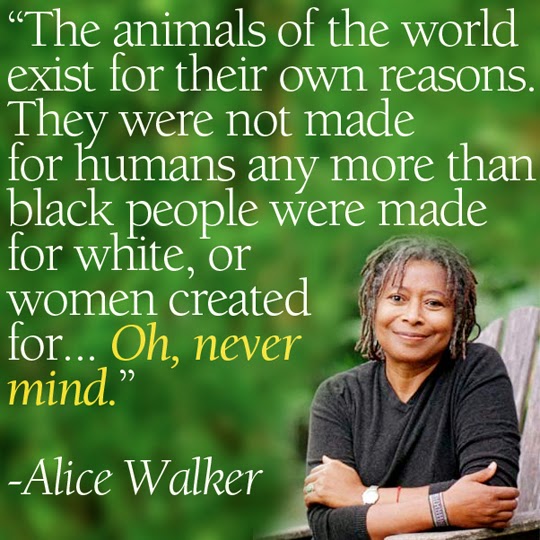
I was reminded this the other day when my friend Robert Grillo (of the amazing group, Free from Harm) posted part of an interview with famed Pulitzer Prize-winning novelist and feminist Alice Walker, expressing disappointment that she, who once wrote very movingly of how humanity’s cold betrayal of the animals compelled her to stop consuming them, has resumed eating animals again. The same Alice Walker who once wrote, “The animals of the world exist for their own reasons. They were not made for humans any more than black people were made for whites or women for men,” apparently no longer agrees, at least in her actions, with this stated view. In an interview after the publication of her book of essays inspired by her life with her flock of backyard chickens, when the interviewer expressed surprise that she eats birds, Ms. Walker said, “I know, I know. It's a contradiction and I have been a vegan and I've been a vegetarian, but from time to time, I do eat chicken. I grew up on chicken and I accept that.” In direct opposition to her powerfully articulated position years before, it seems that now, the chickens were “made” for her and this is justifiable because that was how she was raised.
She accepts how she grew up as an excuse to continue eating animals. I don’t.
Like Alice Walker, I grew up eating chickens (and eggs and cheese and cows and turkeys and...) but that is not where the story ends. That was how I was raised, yes, but I have kept evolving. So have millions of other people who do not accept that our history is carved onto us as our destiny. Still, how many times have I heard people say, in an attempt to justify current habits, that they “grew up on the veal parmigiana that my Nonna made” or “I was raised in a family that ate a lot of meat,” or “Polish food is very meat-centric and that was how I grew up,” or whatever it is that they say? A lot. It’s especially saddening, though, when the person who gives voice to this tired rationale is so highly respected for her penetrating depth and powerful mind. If even Alice Walker, someone who once wrote about empathy in such a heartfelt and moving way, abandons her convictions because she “grew up on chicken,” I’m going to hazard a guess that the concept of history as destiny is a pretty ingrained one that many of us hold as true.
Here’s the thing, though: Unless you grew up on a vegan commune, most likely, you grew up eating a lot of meat and animal products. I honestly don’t think I had a salad until I was in high school, and certain things (including most of the mainstays of my diet today), I didn’t have until college and beyond. I was well into my twenties before I learned that kale was something people actually ate, not just an inedible decoration on a buffet table. Nutritional yeast was the fairy dust that wouldn’t blow into my life until my late twenties. I grew up on all the same familiar stuff that every kid on my block grew up eating in that era. A raspberry Pop-Tart for breakfast. A bologna and cheese sandwich in my lunch box. Spaghetti and meat sauce with that weird frozen garlic bread that I loved for dinner. I also grew up on the ethnic dishes of my grandmother’s cooking. This was my food environment.
When people say that they grew up eating animals as if this gives them a pass to continue doing so, to me they are implying that those who currently do not eat animals didn’t grow up the same way - but this is untrue. Also, in addition to our food culture, there are other family legacies we may have been raised with in our households. Legacies of abuse. Legacies of addiction. Legacies of all sorts of things we don’t necessarily want to carry over into in our own lives. These legacies may feel comfortable to us because they are familiar but if they harm ourselves or others, how can we justify not trying our best to break the cycle?
I very much understand the pull to continue eating the dishes that we associate with comfort, nurturing and love. If there is one thing I’ve learned, it’s that food is deeply emotional to us. The food from my grandmother represented her in a way: it seemed to be suffused with her unique essence, the one I just wanted around me all the time. What I loved, though, wasn’t the chicken or the matzo balls: what I loved was my grandmother’s spirit and what she meant to me, how I felt when I was around her, what she represented in my life. I loved her, not the food. Still, to be able to call up her spirit whenever I miss her, I can eat the foods she used to make, but I can create them with my values of today. I don’t have to give up anything, and there is nothing like the feeling of accomplishment when I’ve been able to recreate something she used to make - and the feeling it stirs up in me of viscerally remembering her again - without compromising who I am.
Our history is not a straight line to our future and thank goodness for that. If it were, we’d have handy excuses for all kinds of behaviors that are harmful to ourselves and others. The way we were raised leaves an imprint on us but doesn't obligate us to continue it. My grandmother loved me as I was and I feel that in not compromising while recreating the dishes she made, it is an active way of continuing to love her, to honor her memory and relive our time together. Love is dynamic and creative, it isn’t static and frozen in time like a museum piece. How we were raised is an influence but not the final word on how we are to unfold. When we choose to no longer participate in practices that we no longer agree with, we are not erasing our histories but we are taking an active role in shaping who we are to become.
You grew up on chicken, Alice Walker. Well, so did I. I’m not going to use that as an excuse to compromise myself, though.
Wednesday, March 12, 2014
I Loved Him Like a Champion: The Ones Who Shape Our Hearts
It was twelve years ago today, March 12, when I left Lenny to go to my birthing class for the baby who would be born exactly three months later, on June 12. When I left Lenny, he was resting on our balcony, his favorite spot in the home, enjoying the first day of gorgeously mild breezes and sun after a long Chicago winter. He wasn’t well, though.
After a completely ordinary Sunday morning and brisk romp in the park a few days before, Lenny became suddenly stricken with seizures and was showing signs of a stroke, but his vet wasn’t sure because not everything added up. It was a very difficult and heartbreaking time, right on the cusp on bringing our baby into the world, the new soul whom I couldn’t wait to introduce to Lenny, my first angel. That afternoon when I said goodbye to him on the balcony, Lenny had eaten a little better than he had the previous few days and as anyone who has cared for an ailing loved one knows, you cling to these small glimmers of hope like they are lifeboats in churning waters. Maybe he is getting better. Maybe it wasn’t a stroke but just a weird virus. The little mental tricks I played on myself, that reliable habit of magical thinking that Joan Didion wrote of in her memoir about dying, loss and trying to get an upper hand on uncontrollable circumstances, got me through those days.
I hadn’t left Lenny’s side since he’d first become ill but that night was our final Bradley Method class after eight weeks. We were all going to be first-time parents and we’d developed a close bond over the weeks. We wouldn’t see everyone together again until after we’d all had our babies in mid-summer. John and I discussed it; with a heavy and conflicted heart, I decided we should go to the last class and come home early. Lenny was on the mend, I told myself. He had even walked to the balcony by himself. Before I left, I sat with him on the balcony, the gentle wind blowing on his fur, and he looked at me with weary brown eyes that were nonetheless full of love, gently wagging his tail a few times, another sign to me that I should be hopeful. I got as close as I could with my big pregnant belly to that face that I loved, kissing his soft muzzle. It was our last class, some of the women would be giving birth within a couple of weeks, but through the hugs and all the excited jitters, all I could think about was Lenny.
When we came home after class, something made me start calling Lenny’s name even before we were in the door. John and I both rushed to the balcony and Lenny was still there, exactly where he was when I’d left. He was lying on his side, stiff already, his mouth drawn back, the cool yellow light shining on him. I saw him for just a second before I started screaming. My Lenny, my first baby. He was gone.
Lenny came into our lives eight years before, scrappy, street-smart and grungy, from a negligent home that routinely let him run loose on the streets of his north side Chicago neighborhood. My friend, an avid animal rescuer, had been trying to catch him for weeks but he’d always managed to evade her. She saw him running in the street on the Fourth of July, terrified and disoriented by the fireworks shooting up everywhere. Not long after that, my friend managed to coax him close to her with some food and, using a slipknotted leash hidden behind her back, she was finally able to catch him. She couldn’t keep him so she asked me if we could foster him until he could be adopted. Yes. John and I went to her apartment and met the dog she had named Lenny. He had a BB pellet embedded in the top of his head that his skin had grown over, teeth yellow with tartar, and just had gone through a second flea bath. He was a muscular beagle-basset mix with a big, gorgeous beagle head affixed to a speckled, low-slung basset body, his front legs warped inward and paws pushed outward in a permanent plie position. Lenny was an unconventional looking fusion of a dog but he wore his uniqueness with a show dog’s grace and pride. He also had the most beautiful, soul-stirring eyes I’d ever seen on any species. The longer he lived with us, the more his dignified essence emerged. He grew into his natural self.

We had eight years of purely joyful companionship together, complete compatibility. How often can we enjoy something like that? I told Lenny every day that he was my angel and I think he understood. It isn’t really accurate to call him my first baby, though, as he wouldn’t have that. He had to be an equal or he had no use for you. He was my canine soul mate and our communication was so effortlessly natural that words would have only served to complicated things.
There is something about that unique connection with another species, one where we have very little if any verbal language that can be understood between us, that can foster a deeper bond than we might with other people. Our human attachments can be so complicated, so fraught with insecurities, game-playing and misunderstandings, that being able to relax in an uncomplicated, loving companionship together is a rare stroke of great fortune in life. Having that bulls-eye met of truly recognizing and rejoicing in one another on an emotional level is even more rare and exquisite. Loving that immaterial, distinctive spark of another - what we call the soul - and having that love returned back to us is something that is clearly one of the most invaluable treasures in life.
I believe that the concept of the soul as we use it is an arbitrary and romantic human construct. Excluding other animals from those who can possess souls is an example of our myopic arrogance. I also know that it would be hard to do to animals what we do to them if we agree that they have souls. It’s much easier if we think of them as soulless beings with just material forms and bodily functions. Anyone who has ever crossed the species’ barrier even briefly to connect with another on that emotional level should understand that this thing we call a soul - that spark within, that immortal, divine essence - is not exclusive to humans, though. I’d known this before Lenny came into my life but it was through our companionship that I really internalized it. Whatever this quality is that we call a soul, Lenny had it and so do billions of other beings not normally included within the parameters of what we consider capable of having one.
Being with Lenny molded, sculpted and ultimately shaped my heart into something altogether different than it was before we’d met. I like to think that I did the same for him. Before I left him on March 12, that ember was still in his eyes but, in retrospect, it was growing dimmer. We looked at each other, just being together, and I scratched his head, his velvety ears. He looked at me with such an expression of love that I immediately recognized my late grandfather in his gaze. It was exactly how my grandfather looked at me. That was our last communication before I left, a parting gift that I return to in my mind all the time.

I can say with all honesty that I have messed up many things in life but I loved Lenny like a champion. I gave him every last ounce of what I had in my heart and, surprise, surprise, I found there was always more. I’m so grateful to have been able to recognize that spark in him and he recognized mine. Through knowing Lenny, I will never again believe that souls are the exclusive province of our species.
Wednesday, March 5, 2014
Being Vegan in this Messy World
“...Perfectionism is very dangerous because if your fidelity to perfection is too high, you never do anything.” - David Foster Wallace
I’ll never forget how defeated I felt when I first learned that I could never be truly vegan. All because of a pair of shoes and a Shriner clown. I should probably back up a bit...
When I first went vegan in the mid-1990s, animal-free replacements weren’t as easy to find as they are today. That first year after I stopped purchasing animal-based items, I was in relentless pursuit of a pair of cute, leather-free shoes and, after months of fruitless catalog research and calling companies, I’d finally found the ones. (Imagine me in black-and-white footage if you will; this was how we rolled back in the quaint pre-internet days.) The shoes had a chunky three-inch heel (oh, how I love a good chunky heel), they were black (of course), they buckled (joy!), and, most important for vegan shoes, they weren’t Converse and they didn’t exude a humorless Christian missionary worker vibe (ding-ding-ding!). They were perfect. They even had a name, like the Charlottes, or maybe I named them that myself because I’m weird and they were that significant. I stared far too much at the picture I had cut out of my catalog and I think I raced home every day from work to see if the magical UPS truck had made the delivery until that amazing day when I spotted the box on our front porch. Usually this sort of anticipation leads to disappointment but these shoes did not disappoint. To the contrary, they were even better in person. They easily made the transition from casual to dressy; the first time I wore them, they felt like they were molded my specific feet. Just putting them on made me feel more confident of my core beliefs: every time another seemingly impossible challenge was checked off the list - in this case, stylish shoes made without animal skins - it seemed like a viable vegan future became closer within reach. These shoes symbolized the future of veganism to me, as silly as that sounds. That’s a lot of pressure on a simple pair of cute shoes.
About a week after they arrived, I was at a circus protest, strutting around in my still-dazzling Charlottes. It was a pretty intense day, the last performance of the run there, and clowns from the Shrine Circus - I’m not speaking pejoratively as they were actual clowns - were outside and more aggressive than usual, openly hurling invective at the activists. One particularly hostile clown in a blue wig really had it out for me and trailed me as I leafletted. Being a sucker for the absurd wherever I can find it, I saw the humor in the situation. It’s not every day you have your own personal clown in a blue wig and red nose following you around and yelling, which was actually scaring the parents and their children more than anything in the leaflets I was handing out would do. The calmer I was, the angrier he became. In other words, it was going exceptionally well. Or it was until that awful turning point.
As I went back to get more leaflets, he continued shadowing me, this time loudly engaging another clown so I could hear him. “What a hypocrite,” he spat. “Look at her wearing shoes that come from animal skins.” I turned around and told him that that wasn’t true, these weren’t leather. “Oh, but what about the glue in the shoes,” he sneered, as much as a clown can manage a sneer with a big foam nose getting in the middle of his face. “Glue comes from animals. Don’t you know that? I guess those animals don’t matter.” He had me. That had never occurred to me; I tried to smile and shrug it off but in truth, I was devastated. Even after working as hard to find them as I had, my shoes were still drenched in suffering. The luster was off my Charlottes. I was humiliated but, worse than that, I was demoralized. I went home, put my shoes back in their box like I was placing them in a coffin and cried for a good hour.
That night I questioned if it was possible, this dream, this ideal. I wondered if it was just another one of my utopian dreams. Having been called naïve since my earliest recollections, was my passionate vegan ideology just another display of my gullibility? For a perfectionist like me, I knew that if I couldn’t do this thing all the way, it would nag and tear at me until I just gave up the ghost and admitted the obvious: it was impossible. Veganism was impossible. Before this thought could really take root, though, another followed close behind and this was what both freed my spirit and allowed me to continue on this path as I have for nearly twenty years.
We live in a flawed world and I am doing my best in it.
From the wool sweaters we inherited from our late grandmothers to car tires with stearic acid, there are seemingly endless points of entry through which both blatant and covert products of animal origin can enter our lives, even those who live with borders that are carefully maintained to keep them out. In that moment when my despair turned around, I was no longer feeling defeated but relieved by acknowledging the facts: we live in a world that is profoundly rooted in animal exploitation. As the world has become more ensnared in animal agriculture specifically, more outlets have been found to find a place for every last molecule the industry can extract from an animal’s corpse, which is why the use of animal products is so pervasive to the point of being impossible to completely eradicate from our personal lives. That night, I realized that I didn’t have to choose between the present and possibility. The present could peacefully coexist with possibility as I worked toward my ideals in this imperfect world. Like those who wait and wait (and wait) for the perfect conditions to line up in order to go toward their dreams, it is this notion that things have to be just so in order to move toward our goals that is the fantasy, and it is a destructive fantasy that keeps us leaden, stuck, and hemmed in.
Ever since that day, I have messed up, I have made mistakes, I have realized that animal products have sneaked past my guard but I always try to learn and do better. Each time it happens - infrequent these days - I am reminded that there is a lot of work to do in this flawed world. The disappointment inspires me to push ahead with this very important work. Hanging my head in shame and beating myself up does nothing for the animals or creating a new, bold, integrated way of living. So today when someone tries to imply that because we can’t be perfect, we should just give up trying, this is what I say, “We don’t live in a vegan world yet. I‘m working on that. What are you doing to create a more compassionate life for yourself and others?”
We live in a flawed world with deeply entrenched, often hidden systems of violence woven through it. Vegans didn’t create this but we are actively forging creative solutions to it. I can find peace in this. I hope you can, too. And my Charlottes? I wore them until they fell apart six months later. (Damn those early vegan shoes...)
Wednesday, February 26, 2014
Ten Reasons Why This Broccoli is More Appealing Than This Plate of Bacon
1. Unlike pigs, this broccoli never had its ears notched, its tail docked, its teeth clipped with pliers or was forced to undergo castration without anesthesia. Broccoli doesn’t have ears, tails, teeth or genitalia and it does not possess sentience as we define it.
2. Unlike pigs, this broccoli never had to endure multiple forced impregnations, babies taken from it shortly after their birth and living in narrow structures that restrict full movement. None of these would be replicable to a broccoli.
3. Unlike pigs, this broccoli is not producing an enormous quantity of fecal waste that is being collected in poorly regulated lagoons that spill over and pollute our groundwater. You can observe a broccoli plant all night and all day and you will not find evidence of it urinating or defecating.
4. Unlike pigs, this broccoli is not fed crops that are sprayed with chemicals, which then leech into and spill over into our waterways, creating dead zones in the world’s oceans. Broccoli does not consume feed.
5. Unlike pigs, this broccoli is not regularly given a cocktail of antibiotics and other drugs to keep it from getting sick in overcrowded, unhygienic surroundings. Broccoli does not get sick.
6. Unlike pigs, this broccoli is not trucked in extreme, crowded conditions that exacerbate suffering to slaughterhouses. Broccoli does not have sentience and thus does not suffer in observable or verifiable ways, and it does not go to the slaughterhouse.
7. Unlike pigs, when this broccoli is picked, it does not cry out, try to escape, bleed or convulse. Skin, hair, organs and viscera do not need to be removed. Broccoli is simply picked.
8. Unlike pig farming, growing broccoli is not an indisputably major factor contributing to climate change, which has a ripple effect on everyone, with negative repercussions felt most harshly in the developing world. Broccoli production does not contribute to climate change.
9. Unlike pig farming, broccoli is not given feed that, in order to be produced, has taken over valuable landmass with the mono-crops required to produce abundant cheap meat. Broccoli is simply grown.
10. Unlike pig’s flesh, broccoli does not contribute to clogged arteries, obesity and other maladies that are linked to suffering, disease and shortened life spans. Broccoli is actually considered a food that contributes to human wellness.
Wednesday, February 19, 2014
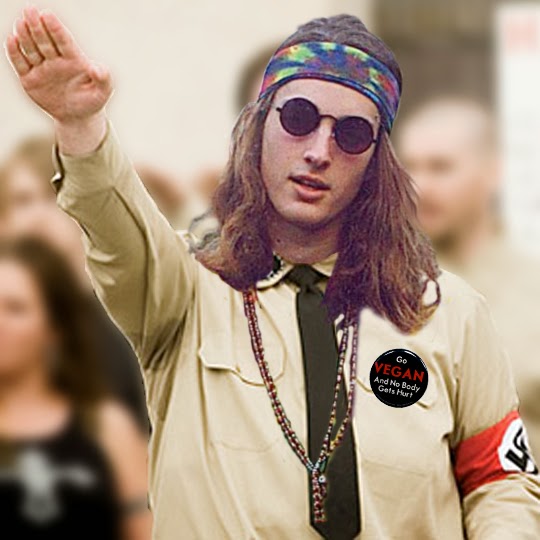
An Open Letter to the Facebook Commenter Who Said that Vegans Are Hippie Fascists
Dear angry guy,
I am guessing that it felt gratifying for you to come to our Facebook page and expose vegans as hippie fascists who are trying to ram our extremist, hardline agenda of consideration and compassion down your innocent throat. I am imagining that you sat up a little taller, your chest puffed out a little more proudly, and you maybe even uttered a sassy little riposte like, “Top that, tree-huggers!” as you hit the return key. Oh, burn. You caught us. We’ve pulled off the nearly impossible by managing to be both hippies and fascists simultaneously (“You will buy me a pack of the very best sandalwood incense and you will like it,”) but we weren’t able to sneak past by the likes of you. You’ve exposed our so-secret-we’re-not-even-trying-to-hide-it-that’s-how-sneaky-we-are agenda: We are going to stomp on your rights and oppress the ever-loving daylights out of you. Ooooh, you are going to be so flipping oppressed when we get done with you. But first, we will disband the U.N., NATO and the ACLU, then we’re going to put all your human rights through an enormous paper shredder (and we are going to cackle as we do it) and then we will stomp on your shredded rights. Finally, we will pour stinky, hippie-certified patchouli oil over the shredded mass that was once your personal rights and we will set it all ablaze because that is how hippie fascists roll. (Oh, we should probably have a drum circle, too, since we’ve got a good bonfire going and, as hippies, we cannot resist.)
That’s right: We are an army of highly organized, powerful and sadistic bohemians who tyrannize humanity with our bunny hugging and constant chugging of green smoothies.
Given that you clearly have our number, one has to wonder why you walked into our den so ill-prepared. On the one hand, you think that we’re all writing our own terrifyingly menacing manifestos (I call dibs on “Mein Kale”), organizing our troops of joy-crushers, green dry-cleaning our grim uniforms and on the other hand, you characterize us as dreamy idealists. Why do you do this? It seems unwise.
I will concede that some of us are hippies (the hippie population within veganism is holding steady at approximately 19%, give or take five percentage points according to the most recent Gallup national poll) so it makes sense at this point to simply examine and address the vegans’ putative fascist tendencies. According to my Oxford Concise English dictionary, this is the definition of Fascism, n. “1 The totalitarian principles and organization of the extreme right-wing nationalist movement in Italy (1922 - 43). 2 (also fascism) a) any similar nationalist and authoritarian movement. b) (loosely) any system of extreme right-wing or authoritarian views. Fascist, n. & adj. (also fascist). I think we can safely rule out the first definition, though the Italian vegans of 1922 - 1943 will have to speak for themselves. Reading the definition, I am going to venture that it is the aspect of “authoritarianism” connected with fascism that is the specific charge levied against us. So this is the definition of authoritarian: adj. & n. “1 Favoring, encouraging, or enforcing strict obedience to authority, as opposed to individual freedom. 2 Tyrannical or domineering. n. A person favoring absolute obedience to a constituted authority.
Apparently we are authoritarians and we are really, really lousy at it. Pitiful! Maybe it’s our hippie nature winning out, but we are supposed to be cracking our pleather whip at all the omnivores and forcing them to follow a joyless diet of steamed cardboard with tears gravy, yet where are we? Rocking out at a measly two percent of the population, barely able to get our parents to understand that we don’t “eat around” dead bodies in the Thanksgiving stuffing, and being served a boiled broccoli plate at the catered annual office holiday party. How is that for a domineering, tyrannical authority figure?
Clearly, we suck at it.
It would maybe make sense at this juncture for vegans to re-assess if we want get that fascist regime off the ground better by honing our latent autocratic tendencies. I think it’s time to study another group and see if we can get that whole brutal despot thing going a little bit more effectively. I think I have the perfect one.
Let’s see: We could develop entrenched systems that keep billions of sentient beings subjugated in order to serve another population and have that industry be underwritten by the government. We could impose our will on their freedom of movement, their bodies, their reproduction and their capacity to raise their own offspring. We could force them to eat food that is not chosen for their digestive systems but to help them reach market weight the quickest. We could keep them locked in a cycle of reproduction until they are considered worth more dead than alive. We could be in control of the method and timing of their slaughter. We could sell their product or flesh and financially benefit from it. We could create an industry that has a proven detrimental ripple effect on human health, water, air, and climate, for starters. We could do all that.
Are you really sure this is the direction you want to go with your argument? Or should I conclude that you’re just pulling random insults out of your ass and you don’t really know what you’re talking about?
I think I’m going with that.
Signed,
Your favorite hippie fascist
Wednesday, February 12, 2014
The Language of Love in So Many Words
When I was very young, love meant many things but perhaps this was when I felt it most: whenever my grandparents came to our house. The tightening in my chest, the happy jitters, and, finally, the sheer combustive, ebullient joy when the sea green Chevrolet pulled up and it was finally them, my grandmother carrying her pocketbook, my grandfather with his adorable, flat-footed shuffle. I loved that purse, that shuffle, and I charged out the door like a panting golden retriever whenever their car pulled up: pure bliss.
Love was also felt on the epic firefly chasing expeditions that turned into sleepovers with my best friend; whenever my sketch pad, charcoal pencil, brain and hand transported me somewhere new; running through the field behind our house, which, in retrospect, was a pretty plain place that became transformed by my lens into the lush meadow of poppies from The Wizard of Oz. Love prior to, say, the fourth grade, was experienced as the pure, unfiltered expression of joy running through my little body.
As I got older, life and love got more complicated, as it does. Love wasn’t what I thought it was, apparently: love was what I read about with disbelieving eyes in Cosmopolitan magazine, it was found in the convoluted, tangled plot twists on All My Children. Love was what I overheard the older girls whispering about in the high school bathroom when I was supposed to be in World History: it was wild, a little scary, and being in it was your ticket out of the tacky juvenile jungle.
The first time I free-fell smack-dab into the sticky spider’s web of love-love, I was 19. In hindsight, I’m certain that I was ridiculous but that’s part of love -- we become ridiculous. I‘m pretty sure that that spring, I skipped down every sidewalk and, in my imagination at least, butterflies seemed to always be flitting around me, songbirds serenading me personally wherever I went. Whenever the phone rang, my heart almost pounded out of my chest. I imagined the first time he would meet my parents, what our apartment would look like (a beautiful vintage building with a courtyard and wood floors and potted herbs growing on our windowsill), our wedding. Our wedding band. My dress. Our song. The honeymoon. And...we broke up after two months.
But love was also the sweet guy with the big smile, the one who couldn’t play mind games if he tried, the one who I didn’t need to tiptoe around. We have this cultural trope of love as a big, nauseating roller-coaster of ecstasy-and-despair (thank you, Emily Brontë) and sometimes it is but sometimes, blessedly, it’s not. Sometimes love is someone who adores you just as you are. Sometimes love doesn’t inspire you to write bad poetry or sit outside an apartment building just to watch the lights go on and off. Because it’s soon to be Valentine’s Day, I am thinking about love in all of its permutations and expressions, which includes the inter-species kind, a variety I’ve found to be no less emotionally gratifying than romantic love. Especially as I’ve gotten older, love has become more and more uncomplicated, back to that simple, pure experience of blissed-out joy I felt as a child. Sometimes animals help me to connect with that most.
This was Lenny. He will have been gone twelve years this March and I still think of him pretty much every day. It took me years to not expect to see him when I got home, even after we moved to a new one. Meeting Lenny was like meeting someone I immediately recognized as being from my own tribe and that is a true rarity. When I got off the train after work, I would rush down the streets, so excited to return to his side, see those enormous café au lait eyes, that whole body wag, that deliciously soft muzzle I couldn’t resist. With my husband, we were a family. The three of us meandered down Route 66 one dusty September, we slept on the balcony together whenever it was too hot inside and he was also at my side when I had a miscarriage before my son was born. Lenny used to lie with his paws on my chest, staring into my eyes and licking my face with an intensity that made me a little woozy. The day he died, Lenny looked at me with cloudy, old man eyes full of love and devotion and I was struck by his expression because it was exactly how my grandfather used to look at me, an unguarded look that said so much. It was a pure love we felt for each other and remains why I cannot accept the notion that we only feel that way for other people.
Part of what made our relationship so rewarding is the same thing people express about their beloved companion animals all around the world: it is not complicated by human emotions and psychological games, it’s pure, simple, not messy. Is it any wonder that as our lives become more complicated with social media, more isolated with technology and more preoccupied with responsibilities, we would seek these sustaining, enriching but undemanding relationships that give so much in return? I grew up in the Chicago suburbs and rarely saw animals other than dogs, cats, birds, squirrels and the occasional chipmunk so the first time I went to an animal sanctuary in the mid-1990s, it was a revelation. I was already vegan but being in the company of these animals - sheep, cows, roosters luxuriating in their freedom on those rolling California hills - confirmed for me that what I felt for them wasn’t just theoretical. I genuinely loved these animals and not just the idea of them; my heart swelled in their company. These animals were different from Lenny in that they were not a part of my life: how could I love those beings I hadn’t met before and would probably not meet again? Doesn’t using the word “love” to apply to strangers cheapen the meaning of the word?
I don’t think so.
When we are vegans, we have unlocked that part of our hearts that is normally closed off. It would serve to reason that when we open up the parameters of whom we love, we also have a more expansive understanding of why and how we love. Why are we speaking out against cruelty? Why are we revoking our own privileges? Why do we risk outing ourselves as unstable, bunny-hugging, dirt worshipers? Because we love. It doesn’t have a to a gushy I-want-to-rub-my-face-in-your-muzzle love; it’s love on its own terms. It’s as simple and straightforward as than that and, as we know, a prevailing characteristic of love is that it operates by its own wisdom. Whether we are talking about the one we plan our futures with, the dog we greet when we come home at the end of the day, the babies we nurture, or the first turkey we sit together at the sanctuary with, love is love is love. I think that part of why people have a hard time fathoming us as vegans is because they cannot fathom loving in this expansive way.
Margaret Atwood was right; there ought to be more words for describing the kinds of love we feel. As vegans, we are expanding the parameters of whom and how we get to love. Love can be messy and complicated but it can also be simple and just as heartfelt. We are vegans because we love, whether they have two legs or four, arms or wings, skin or fur. We are vegans because we love.
Wednesday, February 5, 2014
Radical Storytelling: Capturing Hearts and Minds with Stories That Resonate
Your tale, sir, would cure deafness.” - William Shakespeare, The Tempest
I can’t remember most facts to save my life. This is a shortcoming of mine and it certainly showed itself up on my report cards growing up. A compelling story, however, will bore itself into me like the best sort of tick. Once it’s the story is attached to me, it’s impossible to remove; it’s become absorbed. We can cite all the data we want but at the end of the day, I believe that the stories we tell - richly woven, personal, evocative, transcendent, empathetic - are what influence the people around us the most, becoming part of us.
With our vegan advocacy, we own the vast majority of the significant arguments in favor of moving away from eating animals. We own the ethical debate, we own some very powerful environmental statistics, we own a good deal of the persuasive health arguments. Why then do so many of our attempts to successfully communicate our message misfire? There are myriad simple and complex reasons why people might ignore or push back against our attempts to advocate, ranging from anxiety about change, defensiveness that is outside of our control, or poor communication skills on our part, but I believe that we can overcome obstacles when we learn to meet people where they are at and tell the stories that they find compelling. We actually own the arguments. Now let’s tell the stories better.
We are a species with multiple tools at our disposal for communication - from spoken word to the visual arts to dance to music - for a reason; essentially, our forms of communication have a common root of sharing a story in direct and abstract ways. Stories penetrate us. The best stories can create a shared, universal experience out of a personal, unique one and the reverse is also true. Stories help us to transcend our own skin and see things, including our own lives, through a fresh lens. Along the way, they move us, influence us, make us double over in laughter or collapse into tears. We return to the most compelling stories again and again, in our thoughts and in our words, and as we do, we are changed and we change the world around us. I believe that the stories we tell are our richest resource and currency as communicators of the vegan message and that we are barely scratching the surface of our potential.
When we move others through our stories, we have unlocked part of someone’s heart.
Our goal is a lofty and deeply challenging one: to encourage people to reconsider how they conceive of other animals, and, in this reconsideration, determine that other animals are as deserving of respect and protection as humans. It isn’t enough to change one’s behavior, though: through this radical revaluation of our place in the world, the goal is that people will decide to change their mindset to embrace the principles and practice of compassionate living. We are asking people to willingly give up their privileges, their family customs and their comfortable habits for the sake of others. There is no enforcement here. No one is doing anything illegal. This is grounded in good faith, altruism and kindness for the sake of itself.
I think we can agree that this is a hard sell. Given that, let’s compare two approaches and see what is more moving, relatable and empowering.
“Sixty billion land animals are killed worldwide for food. In the U.S. alone, it’s 10 billion. (This does not include aquatic animals, which are killed in even higher numbers.) Of the 10 billion killed in the U.S., well more than 99% of the animals are raised in an industrial setting. The 10 billion land animals consume two-thirds of the nation’s grain, one half of the nation’s water, one-third of the nation’s landmass and one-third of the nation’s fossil fuel. Animal agriculture is considered a leading cause of climate change. This is why you should go vegan.”
Or...
“It all started when I saw a truck transporting pigs to slaughter on the highway. I’d never given what I ate much thought except on that one day, my dog Sally happened to be sitting in the passenger’s seat. On the other side of her, I could see the the pigs looking out through the tiny little slats in the metal as the truck drove past. I could see snouts and shapes but what really struck me was a pair of eyes I could see through the slats. I looked at the dog I loved so much, and back to the eyes when something struck me: Sally’s eyes looked just the same as that pig’s. They were so expressive. I couldn’t shake having seen those pigs for the rest of the day - they looked scared, confused, but maybe even a little hopeful for breathing the fresh air, seeing the sky. They looked just like my dog would have under the same circumstances. From there, the more I learned about what we do to animals, the less I could contribute to their suffering, and the more I learned, the less I was able to deceive myself. This was why I went vegan.”
In one example, we are barraged with facts and statistics that are so depressing, they can easily make us feel overloaded and disempowered. A common response to feeling overloaded and disempowered is hopelessness and giving up. This is a massive industry, reinforced by history and industry, governments and our own attachments, and it is all we’ve known. Given this, it’s easy to feel bombarded by depressing fact over devastating statistic and, as vegans, we often feel if we just keep shelling out as many truth-bombs as possible, something has to eventually hit our target. At what cost, though?
In the second example, we are told a story. It is humble, honest and unguarded. It is relatable, it has something the listener can grab on to and filter through their own experience. It’s not lecturing; it’s not hectoring. It’s honest and simple but not boring: it’s told in a personal, vivid way that people can imagine in their own mind’s eye. The story didn’t tell someone how to think: it left that up to the listener, and simply illustrated how the storyteller thought.
The stories that touch us resonate. We return to them again and again. We think about them when we’re walking to school, when we’re in the bathtub, when we’re grocery shopping. The stories pull us to them because we are a communicative species and we make sense of the world around us and our place in it through stories: this is part and parcel of being human. We need to learn how to tell our stories better because, as we know, the facts are out there and they are compelling. What we need to do is get people to feel and disempowerment is the wrong route to go if we want them to not to turn off the capacity to feel.
Facts, data, and statistics are essential to the big picture of influencing people. Essential. They ground our stories in reality, in something of substance, in the non-subjective. Our stories, ideally buttressed with select facts, will build the perfect structure, filled with the unique details that make it memorable but also the support beams that are so necessary for it to remain standing. How do we do this, though? How do we construct the stories we have in ourselves to make them move and inspire? That’s a big question. I have some thoughts and I will be sharing them in the coming weeks. In the meantime, have you ever been told a story that has changed your life? Have you ever told a story that changed someone else’s life? Please share in the comments.
Subscribe to:
Posts (Atom)